
Some Say Gold’s Epic Run Is Ending. Are They Right?

And just like that, a wave of chatter suddenly has ensued suggesting gold’s epic run is at an end and that investors should expect prices of the metal to decline significantly in the years ahead.

Among the most prominent voices forecasting the demise of the gold bull are those at Citi. Last month, Citi’s global commodity team essentially said gold’s done all it’s going to do, and that by the end of next year investors could see the price of gold roughly 25% below present levels.

The culprit, say Citi strategists, is a peak in the demand for gold as a safe-haven asset and hedge against economic and geopolitical distress. Citi believes the risk premiums that have benefitted gold for so long – particularly those rooted in tariff-policy distress and high-profile military conflict – are in the process of abating as the feared worse case scenarios now seem unlikely to be realized.

Global Banking Giants See Gold Losing as Much as 30% From Here

Citi thinks we could see gold reach as low as $2,500 per ounce as 2026 closes out, with the bank expecting “to see the President Trump popularity and U.S. growth ‘put’ kicking in, especially as U.S. mid-terms come into focus.”

Still another prominent voice forecasting substantially lower gold prices in the years to come is that of James Steele, chief precious metals analyst at HSBC. Like the analysts at Citi, Steele has grown dismissive of concerns about debilitating global trade conflict manifesting, given President Trump’s demonstrated willingness to seek compromise in the interest of avoiding economic bloodshed.

Steele has made particular note of the simultaneous disinclination of risk assets to fold and of gold to retest the all-time high of $3,500 first reached in April as evidence that investor demand for safe-haven protection is waning.

As for his long-term outlook for the yellow metal, Steele is even more bearish than Citi, expecting to see gold drift as low as $2,350, which would translate to a 30% drop from present levels.

So…what of the prognostications that the gold bull is, indeed, on his last legs and approaching the point of exhaustion?

Are they correct?

There’s no way to know for sure right now, of course. But others who’ve been at this metals game for some time appear to be channeling Mark Twain right now, believing that rumors of the gold bull’s (impending) death have been greatly exaggerated.

Noted Metals Analyst Dismisses Big-Bank Projections of Gold Dive: “Their Default Mode Is Skepticism

One of those entirely unconvinced that gold’s run is nearing an end is Brien Lundin, editor of Gold Newsletter and host of the prestigious New Orleans Investment Conference.

During a recent appearance on the Money Metals Podcast with analyst Mike Maharrey, Lundin was unfazed by the “doom-and-gloom” outlook for gold on the part of those such as Citi and HSBC, suggesting that concession to an historically gold-averse posture is to be expected of many institutional investors.

 “Their default mode is skepticism,” said Lundin. “Even when gold hit $3,500 earlier this year, they were late to the party.”

Lundin thinks those who see gold’s viability largely in terms of shorter-term drivers such as tariff distress are making a mistake, because doing so is blinding them to the more foundational influences on the metal that he and others believe keeps it viable through at least the foreseeable future.

Among those foundational influences, says Lundin, is central bank gold demand, which has been at or near record levels since 2022 and is projected to remain exceptionally vigorous through at least the end of next year. According to the World Gold Council’s recently released 2025 Central Bank Gold Reserves Survey, fully 95% of respondents said they believe global central bank gold reserves will increase over the next 12 months, while analysts at J.P. Morgan are among many who expect annual central bank gold consumption to remain around the 1,000-metric-ton pace through 2026.     

“This is the first bull market in modern history driven by central bank demand,” Lundin noted during his podcast appearance. “They’re not emotional. They buy for strategic reasons and they don’t stop on corrections.”

J.P. Morgan Projects $4,000-Plus Gold Next Year Largely on Strength of Central Bank Demand

Note, however, that it’s not just metals-centric analysts such as Lundin who expect gold to continue demonstrating impressive resilience through the foreseeable future.

During a recent appearance on Bloomberg Television, Grace Peters, global head of investment strategy at J.P. Morgan, said she sees gold surpassing $4,000 within the next 12 months. And like Brien Lundin, Peters believes relentless central bank demand will underpin the achievement of that price target.

“Looking 12 months forward, north of $4,000, we think, would be a new reasonable price target for gold, with key drivers being still emerging market central banks,” Grace Peters said. “When you look at EM (emerging market) positions versus DM (developed market) central banks, there’s quite a lot of room still for EM central banks to position closer to where their DM counterparts are.”

My Take: Gold Should Continue to Thrive as Long as Its Structural Drivers Remain Intact

In my opinion, it is difficult to argue against a structural bull case for gold, even after all the metal has accomplished during what has been a run for the ages already.

The expectation that we’ll continue to see high levels of gold demand by central banks – institutions which are so price insensitive that they can keep buying the metal without regard to how expensive it becomes – clearly is a part of that structural case. But so, too, of course, are the reasons why central banks are devouring gold, including growing geopolitical risk in a deglobalizing world, concerns about dollar stability amid surging U.S. debt loads, and anxiety over heightened political risk in developed economies.

These are among the most valid and deeply rooted reasons for owning gold. And the expectations of their continued relevance mean they can and should continue to drive gold demand not only among central banks, but among sovereign wealth funds, institutional investors and even retail investors…a broad-based wave of gold demand which is likely to push the price of the metal to $4,000 and beyond in the years to come.

This post is created and published for general information purposes only. The Gold Strategist blog and Bob Yetman disclaim responsibility for any liability or loss incurred as a consequence of the use or application, either directly or indirectly, of any information presented herein. Nothing contained in this post – or any other post featured at this blog – should be construed as a solicitation or recommendation to engage in any financial transaction. You should seek the advice of a qualified professional before making any changes to your personal financial profile.

Economic Week in Review: Nonfarm Payrolls Surprise to the Upside, Private Sector Jobs See First Drop in Years, Manufacturing Keeps Struggling, and More

Hello, my friends!

This was, of course, an economic week shortened by the July 4th holiday, but there still was no shortage of high-profile data to process, including several key updates on the health of the labor market.

June Nonfarm Payrolls Crush Estimate, but Report Yields Disquieting Details

On Thursday, the Labor Department released the week’s highlight economic data report – nonfarm payrolls for June – which revealed a bigger-than-expected increase in jobs last month.

The government’s numbers showed that the economy added 147,000 jobs in June…slightly more than the 144,000 picked up in May and a lot more than the consensus estimate of 110,000.

Notable, too, was where the official unemployment rate landed: 4.1%, which was a wholly unexpected improvement on May’s 4.2% rate. Heading into the week, economists were looking for headline U-3 unemployment to have ticked up in June to 4.3%.

While the report’s macro numbers were largely praised by observers, a closer look at the data reveals a jobs picture that’s not all sunshine and roses.

For one thing, the surprising drop in the unemployment rate was attributed to a decline in the number of people looking for work. According to the data, the percentage of Americans aged 16 and older who were working or looking for work in June fell to 62.3%…the lowest level since December 2022. The number of people who hadn’t looked for a job in the previous four weeks jumped by 234,000 to 1.8 million.

Other potentially concerning information conveyed by the report includes the percentage of unemployed workers who’ve been jobless for 27 weeks or longer – that rose to 23.3%, which is the highest it’s been in nearly three years. Also, jobs in the manufacturing sector…responsible for 10% of the nation’s economic output…sank for the second straight month. And the length of an average workweek declined by one-tenth of an hour last month, to 34.2 hours total.

Job Openings Surge in May…but Hiring Rate Remains at Lowest Levels in Nearly a Decade

Other widely followed jobs numbers released this week also seemed to imply a labor market that simultaneously remains resilient and a bit fragile.

One of those metrics is the May Job Openings and Labor Turnover Survey – known less formally as the JOLTS report – released on Tuesday by the Bureau of Labor Statistics.

According to the data, job openings in May unexpectedly rose to 7.76 million…a six-month high that’s well above the 7.39 million openings posted in April and considerably more than the 7.3 million openings projected by economists. 

Still, openings, overall, remain about 35% below where they were three years ago. And while job openings have ticked up, at 3.4% the hiring rate remains around its lowest level in nearly a decade.

Layoffs, however, dropped to 1.6 million in May, putting the rate of layoffs near all-time lows and making the unfortunate hiring rate appear less ominous.

“Hiring remains depressed, but that is less worrisome than it would be otherwise because layoffs continue to be low,” said Nancy Vanden Houten, lead U.S. economist at Oxford Economics.

Private Sector Payrolls Post First Decline in More Than Two Years

Another popular measure of labor market strength, the National Employment Report from payroll processor ADP, also appeared to convey the image of a jobs picture that’s both steady and uncertain.

According to the report released on Wednesday, the private sector lost 33,000 jobs in June, the first outright decline since March 2023. That’s well off May’s uptick by 29,000 jobs and an obviously big letdown from the increase of 95,000 jobs that had been the consensus estimate of economists polled by Reuters.

Dr. Nela Richardson, chief economist at ADP, noted that while uncertainty continues to permeate the macro job market, that same uncertainty is keeping layoffs in check as employers struggle to navigate the economy right now.

“Though layoffs continue to be rare, a hesitancy to hire and a reluctance to replace departing workers led to job losses last month,” said Richardson.

In fact, planned job cuts by U.S. employers saw a big drop in June according to global outplacement firm Challenger, Gray & Christmas, declining by 49% from May to land at 47,999.

Chicago-Area Manufacturing Activity Sinks Deeper Into Contraction Territory

This week also saw the release of a couple of key measures of manufacturing activity; one regional and one national…but neither particularly hopeful.

First up was the June Chicago Business Barometer, known less formally as Chicago PMI (Purchasing Managers’ Index), released on Monday by the Institute for Supply Management (ISM).

ISM reported that the metric came in last month at 40.4…a tenth of a point below the May reading but well below the 43.0 projected by economists polled by The Wall Street Journal.

In addition to falling short of economists’ forecast, last month’s number marked not only the lowest for the barometer since January but also proved to be the 19th straight month the index landed below the critical level of 50 that distinguishes contraction from expansion in the manufacturing sector.

Notably, in response to a survey question asking Chicago-area business owners how they see their own business activity growing in the second half of the year, 45% of them said they expect to see either no growth or a decline in activity through the rest of 2025.

Nationwide Manufacturing PMI Contracts Fourth Straight Month and 29th Time in Previous 32 Months

The following day, Tuesday, ISM was back to provide the latest update on production activity throughout the country with the release of its proprietary Manufacturing Purchasing Managers’ Index for June.

Although the index landed at 49, putting it in contraction territory for the fourth straight month as well as for the 29th time in the last 32 months, the number was a slight improvement over both April’s 48.5 reading and the 48.8 measure projected by economists.

“In June, U.S. manufacturing activity slowed its rate of contraction, with improvements in inventories and production the biggest factors in the 0.5 percentage point gain in the Manufacturing PMI,” noted Susan Spence, chair of the ISM Manufacturing Business Survey Committee.

However, the better index numbers seem to belie considerable frustration and even worry on the part of many U.S. producers, with one survey respondent saying:

“Tariffs, chaos, sluggish economy, rising prices, Ukraine, Iran, geopolitical unrest around the world — all make for a landscape that is hellacious, and fatigue is setting in due to dealing with these issues across the spectrum. Unfortunately, this is just the beginning unless something drastically changes.”

That’s it for now; enjoy the rest of your holiday weekend!

This post is created and published for general information purposes only. The Gold Strategist blog and Bob Yetman disclaim responsibility for any liability or loss incurred as a consequence of the use or application, either directly or indirectly, of any information presented herein. Nothing contained in this post – or any other post featured at this blog – should be construed as a solicitation or recommendation to engage in any financial transaction. You should seek the advice of a qualified professional before making any changes to your personal financial profile.
Gold’s Improving Viability as a Long-Term Asset

Is gold on the way to becoming a universally regarded core portfolio component – even a mainstream asset?

Among the more compelling pieces of evidence in support of that idea is the metal’s improving reliability as a long-term capital appreciation instrument, a virtue highlighted in a recent Forbes piece by Alex Shahidi, managing partner and co-CIO at Evoke Advisors.

“Since 1971, when the U.S. came off the gold standard, the precious metal has delivered strong, competitive returns,” Shahidi writes, “nearly matching global equities over the long term, with annualized returns of 8.4% compared to 9.2% for global stocks.”

Shahidi’s assessment comes on the heels of a similar conclusion drawn by the World Gold Council. In a report published earlier this year on gold’s appropriateness as a strategic long-term asset, the WGC said:

“Looking back over more-than half a century since the US gold standard collapsed in 1971, the price of gold in US dollars has increased by 8% on an annualized basis – a performance comparable with that of equities and higher than that of bonds over the same period.”

The WGC also crowed about gold’s “shining” performance through a variety of more recent time frames, noting:

Gold has performed well over the past 1, 3, 5, 10 and 20 years, despite the strong performance of risk assets.”

Analyst: Since Millennium’s Start, Gold Has Returned 10.1% Annually vs. 5.9% for Global Equities

Of particular note is just how well gold has performed since the beginning of the millennium, something else of which Shahidi makes specific mention:

“Notably, since the turn of the millennium, gold has significantly outpaced equities, delivering 10.1% annual returns versus just 5.9% for global stocks, by my calculations. This remarkable track record highlights gold’s enduring value as an investment, especially in the modern era.”

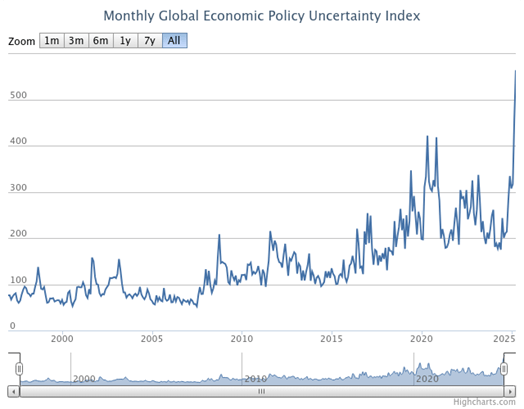
Gold’s impressive performance numbers over the last quarter-century highlight something else: the significantly greater prominence of uncertainty on the global economic and geopolitical stage.

To be sure, gold has a multitude of impactful drivers…including consumer demand, which is an influence that’s far more relevant during robust economies; not exactly the periods during which a perceived safe-haven asset is expected to thrive.

In fact, the WGC details, consumer demand – rooted in gold’s utility to both the technology and jewelry industries – accounts for roughly 40% of the metal’s overall demand.

Still, it remains gold’s appeal as a crisis asset…an asset inherently poised to strengthen amid distress, both real and feared…that appears to be its most dynamic catalyst. And in an environment characterized by greater overall and chronic uncertainty, one might expect gold to, in turn, post better numbers over extended periods.

Coincidence? Gold’s Long-Term Performance Has Improved With the Surge in Global Uncertainty

That’s exactly what it’s been doing. As Alex Shahidi points out, gold has managed to best global stocks – in terms of average annualized returns – by roughly 70% since 2001; a period, not so coincidentally, that has seen popular uncertainty metrics – including the World Uncertainty Index and Economic Policy Uncertainty Index – rise to their highest recorded levels, fueled by a seemingly endless string of profound global shocks that include:

  • the 9/11 attacks;
  • the global financial crisis;
  • the COVID-19 pandemic;
  • Europe’s largest ground war since World War II;
  • and obscene levels of fiscal profligacy poised to trigger a massive global debt crisis.

Chart courtesy of Economic Policy Uncertainty

Central Banks Have Been Net Purchasers of Gold Every Year Since 2010

It is, in fact, this rising uncertainty – particularly that which threatens dollar reliability and stability – that’s largely responsible for another highly impactful source of gold demand: central banks. Central banks have been net purchasers of gold every year since 2010. And since 2022…the same year Russia saw half its global reserves frozen by the West as punishment for Moscow’s invasion of Ukraine…central bank gold demand has been at or near record levels, something Alex Shahidi references in his public embrace of the metal.

“With its surprisingly strong historical returns over the long run, high liquidity and strong central bank support, it can be a valuable portfolio tool that offers diversification, inflation protection and stability during market turmoil,” Shahidi writes, adding:

“While not a conventional holding for all investors, gold’s unique attributes and proven track record make it worth considering as part of a well-diversified investment portfolio.”

For that matter, Shahidi’s pro-gold posture is hardly “conventional” for a key person at a billion-dollar asset manager. But in the words of the immortal Bob Dylan, the times they are a-changin’. And the way in which they’re “a-changin’” suggests the possibility that uncertainty might become a permanent part of the global landscape.

Should that disconcerting eventuality come to pass, then gold may be viewed not only as a standard portfolio holding, but also as a hedge deemed so critical that those advisors who opt against owning it on behalf of their clients could one day be seen as negligent for refusing to do so.

This post is created and published for general information purposes only. The Gold Strategist blog and Bob Yetman disclaim responsibility for any liability or loss incurred as a consequence of the use or application, either directly or indirectly, of any information presented herein. Nothing contained in this post – or any other post featured at this blog – should be construed as a solicitation or recommendation to engage in any financial transaction. You should seek the advice of a qualified professional before making any changes to your personal financial profile.
Economic Week in Review: Powell Faces Music in Congress, Inflation Gets Hotter, Consumers Lose Confidence, and More

Hello, my friends!

It was another ultra-busy week in the economy, one that saw a variety of fresh data emerge, including new numbers on inflation, business activity and consumer confidence. But among the week’s biggest news was Federal Reserve Chair Jerome Powell’s appearance on Capitol Hill, where he delivered his latest Semiannual Monetary Policy Report to Congress.

Powell Emphasizes Policy Caution in Report to Congress

As you might imagine, the near-term outlook for interest rates was the most prominent topic throughout Powell’s testimony. The chair spent much of his time explaining the central bank’s cautious approach to any further policy-loosening, and attributing that caution to what he said is persistent uncertainty about just how the Trump administration’s tariff agenda ultimately may impact prices.

Powell testified before the House Committee on Financial Services on Tuesday and in front of the Senate Committee on Banking, Housing, and Urban Affairs the following day, delivering identical prepared remarks to each body.

In those remarks, the Fed chair defended the wait-and-see approach he says central bankers are taking now with respect to monetary policy as tariff impacts work their way through the economy.

Tariff consequences “could be large or small,” Powell noted. “It is just something you want to approach carefully. If we make a mistake people will pay the cost for a long time.”

The chair also said that members of the Federal Open Market Committee are “well positioned to wait to learn more about the likely course of the economy before considering any adjustments to our policy stance.”

In his direct exchanges with lawmakers, Powell unsurprisingly found himself the target of those frustrated with the chair’s reluctance to drop rates amid signs of slowing inflation. Ohio Republican Senator Bernie Moreno went as far as to effectively accuse Powell of playing politics with monetary policy, telling him, “You should consider whether you’re really looking at this from a fiscal lens or a political lens, because you just don’t like tariffs.”

But during his two days of testimony, Powell did indicate that he is, in fact, open to lowering rates in the near future if the data justifies doing so.

“I think if it turns out that inflation pressures do remain contained then we will get to a place where we cut rates sooner rather than later,” Powell told Republican Representative Mike Lawler on Tuesday.

As things stand right now, however, few are expecting to see a rate cut before September, with more than 80% of traders betting that the benchmark fed funds rate will remain at the current target range of 4.25%-4.5% through the July policy meeting.

Fed’s Favorite Inflation Measure Shows Price Pressures Reintensified Last Month

In fact, the prospect of a rate cut in July likely diminished further following the release this week of the personal consumption expenditures price index numbers for May, which showed that inflation pressures moved in the wrong direction last month.

On Friday, the Commerce Department reported that headline PCE increased in May at a monthly rate of 0.1% while the year-over-year rate rose at a pace of 2.3%. Both numbers were in line with the expectations of economists surveyed by Dow Jones, but the annual pace represents an acceleration by a tenth of a percentage point over the April rate.

The more disconcerting news was delivered by core PCE, which strips out volatile food and energy prices to get a more accurate look at underlying price pressures. Core rose 0.2% for the month and 2.7% year over year…each a tenth of a point faster than both the April results and economists’ projections.

Notably, the PCE report also showed unexpected drops in consumer spending and personal income last month (-0.1% and -0.4%, respectively), data which otherwise might prompt policymakers to more seriously consider a rate cut next month.

But economists say that as long as inflation is inclined to reintensify, the central bank will sit tight, with Eugenio Aleman, chief economist at Raymond James, suggesting that Friday’s data “will continue to keep the Federal Reserve on the sidelines for now.”

Key PMI Data Suggests Continued Resilience Among Manufacturing and Services Sectors

Also this week, a widely followed set of numbers suggested that business activity in the U.S. remains resilient despite the ongoing threat of potential tariff-related disruptions.

On Monday, the folks at S&P Global revealed that its Flash U.S. Composite Purchasing Managers’ Index ticked down in June but still reflected a solid pace of overall activity this month across both the manufacturing and services sectors.

Composite PMI came in at 52.8…slightly off May’s 53 reading but above the critical level of 50 that separates expansion from contraction in these kinds of diffusion indexes as well as above the 52.2 measure that had been projected by economists.

As for the sector-specific indexes, each of those also landed on more solid footing than economists expected. Flash Manufacturing PMI held at 52 for the second month in a row, higher than the consensus estimate of 51, while Flash Services PMI came in at 53.1…a little off May’s 53.7 but better than the 52.9 that was anticipated.

Note that Flash PMIs are advance estimates of the final numbers that come out at the end of each month and calculated using roughly 85% to 90% of the survey responses.

Commenting on the June numbers, Chris Williamson, chief business economist at S&P Global Market, emphasized the possibility that business conditions may deteriorate from here, saying, in part:

“The June flash PMI data indicated that the US economy continued to grow at the end of the second quarter, but that the outlook remains uncertain while inflationary pressures have risen sharply in the past two months.”

Consumers Grew a LOT More Pessimistic in June  

Finally this week, we received some especially unwelcome news from The Conference Board on Tuesday in the form of its Consumer Confidence Index for June.

It seems the index sank more than five points this month, dropping to a reading of 93 from the 98.4 recorded in May and coming in well below the measure of 99 expected by economists.

The June number also marks the fourth straight month the index has fallen short of the neutral reading of 100. Measures below 100 imply greater pessimism among Americans.

The board reported that respondents to its survey remain particularly concerned about the impact that tariffs still may have on the economy and prices.

On that note, the Expectations Index … a component measure of the overall index … tumbled 4.6 points to come in at a measure of 69. The Expectations Index gauges consumers’ six-month outlook for the economy, and according to The Conference Board, readings below 80 imply a recession could be ahead.

“Consumer confidence weakened in June, erasing almost half of May’s sharp gains,” said Stephanie Guichard, senior economist at The Conference Board. “The decline was broad-based across components, with consumers’ assessments of the present situation and their expectations for the future both contributing to the deterioration.”

“Consumers were less positive about current business conditions than May,” Guichard added.

That’s it for now; have a marvelous weekend!

This post is created and published for general information purposes only. The Gold Strategist blog and Bob Yetman disclaim responsibility for any liability or loss incurred as a consequence of the use or application, either directly or indirectly, of any information presented herein. Nothing contained in this post – or any other post featured at this blog – should be construed as a solicitation or recommendation to engage in any financial transaction. You should seek the advice of a qualified professional before making any changes to your personal financial profile.

CBO: Big, Beautiful Bill Looks Even Uglier After Second Glance

Analysts at the Congressional Budget Office recently took a closer look at President Trump’s landmark budget reconciliation known as the Big, Beautiful Bill…and concluded it’s even uglier than it appeared after their initial passing glance.

Upon completion last week of its second – and more comprehensive – review, the CBO revealed the bill actually could add about $2.8 trillion to deficits over the next 10 years…roughly $400 billion more than the agency’s previous estimate of $2.4 trillion.

Notably, the first number did not account for the manner in which the bill would impact the economy nor the consequential effects on the budget from those impacts. The scope of the initial estimate was limited to the bill’s prospective direct impact on the budget. The updated “dynamic” estimate seeks to account, as well, for the potential macroeconomic effects of the bill, including its anticipated impacts on inflation, interest rates and overall economic growth.

And the CBO’s conclusion? Life under the Big, Beautiful Bill is poised to become even more fiscally precarious.

CBO Sees Legislation Boosting Real GDP by Just 0.5% Over the Next Decade

The analysis is replete with details, but there are a couple of “punchlines” readers would do well not to miss. One is that, in the estimation of the agency, the combination of tax cuts and spending cuts – particularly those to Medicaid and food stamps – would boost real GDP over the next decade by just half a percentage point…far less than the 3%-or-so gain projected by the White House’s Council of Economic Advisers.

Another zinger in the CBO’s fresh review is that the overall cost of the bill could cue a projected 14-basis-point bump in 10-year Treasury rates. This jump would be a direct result of not only the static increase in the nation’s debt load but also the demand for higher rates by investors in America’s debt…investors who expect to be better compensated for assuming greater perceived risk. The pricier debt service that comes with these higher rates is the principal driver of the $441 billion increase to deficits the CBO now sees as likely.

Public’s Share of Federal Debt Poised to Reach 124% by 2034

As for the consequential impact to the public’s share of the federal debt, that now is projected to rise by $3.3 trillion over the next 10 years, up from the CBO’s previous estimate of $3 trillion. An associated implication, says the CBO, is that the ratio of public debt to GDP is poised to rise from 117% in 2034 (based on a January CBO analysis of the nation’s long-term fiscal outlook) to 124%…a figure that many economists say would redline the nation’s already overworked debt engine.

As you might imagine, members of the administration have been critical of the CBO’s dour prognostications. White House spokesman Kush Desai recently suggested the agency seems prone to overlooking key features of the president’s economic priorities that could go a long way to ensuring the nation’s debt does not worsen in the years to come:

“The Trump administration remains committed to an America First agenda of tariffs, rapid deregulation and domestic energy prediction that ushered in historic job, wage and economic growth during President Trump’s first term — prosperity that CBO had also failed to predict back in 2017.”

Except there are few comprehensive analyses of the Big, Beautiful Bill that reach the same optimistic conclusions at which Desai and others appear to have arrived. As the National Review said shortly after the CBO released its most recent assessment of the legislation:

“Not a single independent analysis comes anywhere close to matching Republicans’ rosy growth assumption. Accordingly, the consensus among budget experts is that the megabill will be anything but deficit-neutral, adding trillions of dollars to the national debt by 2034.”

Budget Watchdog: Bill “Not Paying for Any of Itself”

Among those independent analyses at odds with the administration’s outlook (in addition to the CBO’s detailed scrutiny, of course) is that of the Committee for a Responsible Federal Budget, whose senior vice president and policy director, Marc Goldwein, lodged this pointed criticism:

“It’s not only not paying for all of itself, it’s not paying for any of itself.”

The ongoing process of examining – and reexamining – the Big, Beautiful Bill to understand the degree to which it may exacerbate the nation’s already fraught fiscal outlook is hardly without value. But there’s a “bigger picture” element to this discussion of which prudent investors should not lose sight: namely, that even if, by some miracle, the bill does prove to be “deficit-neutral,” that wouldn’t change the nation’s longstanding unsustainable fiscal trajectory.

It’s a fiscal trajectory that’s likely to become an even more profound and impactful stressor of capital markets as politicians continue to put off dealing with it in any meaningful way; but also, a trajectory that could significantly catalyze select safe-haven assets which live entirely outside the U.S. financial system…including – or perhaps especially – gold.

Bank of America Says Debt – Not Geopolitical Risk – Will Be the Catalyst of $4,000 Gold

As a structural portfolio component, some of investing’s most dynamic minds, including Ray Dalio and “Big Short” prophet Porter Collins, are “all in” on gold largely because of its capacity to thrive amid fiscal chaos. So are analysts at a number of investment banking giants, including those at Bank of America, who believe America’s fiscal fragility…rather than ubiquitous geopolitical tension…will be the primary reason gold reaches $4,000 per ounce within the next 12 months.

That Uncle Sam’s fiscal profligacy trump’s kinetic war as a reliable gold driver speaks volumes about not only how unfortunate our macro debt outlook has become…but also how important it may be to be sure the yellow metal is among one’s holdings in the years ahead.

This post is created and published for general information purposes only. The Gold Strategist blog and Bob Yetman disclaim responsibility for any liability or loss incurred as a consequence of the use or application, either directly or indirectly, of any information presented herein. Nothing contained in this post – or any other post featured at this blog – should be construed as a solicitation or recommendation to engage in any financial transaction. You should seek the advice of a qualified professional before making any changes to your personal financial profile.

Economic Week in Review: Federal Reserve Stands Pat, Retail Sales Disappoint, Housing Looks Glum, and More

Hello, my friends! Let’s get right into it…

Fed Leaves Rates Unchanged Once Again, but Still Sees Two Cuts by the End of the Year

Among the biggest news of the week was the widely anticipated decision of the Federal Open Market Committee (FOMC) – the policymaking arm of the Federal Reserve – to hold the federal funds rate at a target range of 4.25%-4.5%, where it’s resided since December.

As has been the case with so many of these FOMC meetings of late, observers were less interested in the entirely expected rate decision, and more curious about the accompanying narrative – including the Fed’s updated Summary of Economic Projections – to get an idea of where policy may be headed.

According to the summary, committee members still are expecting two quarter-point rate reductions before 2025 comes to an end, perhaps a surprise to some who’ve noted the central bank’s reluctance to seriously entertain cuts until it’s satisfied tariff impacts are likely to be negligible.

One significant change that was made to the formal outlook is that Fed officials decreased the number of cuts anticipated in 2026 and 2027 from three to two in each year, implying we’ll see no more than a full percentage point reduction through the foreseeable future after 2025.

As for what’s in store for the rest of this year, while the summary suggests two rate reductions are still in the bullpen, investors should be mindful that’s in no way a done deal.

For one thing, the number of policymakers who said they favor no cuts this year is now at seven, up from the four who said so in March. And for another, Fed Chair Jerome Powell, during his post-meeting press conference, reiterated that the central bank will take as much time as it feels is necessary before deciding to make any material changes to policy, saying, in part:

“For the time being, we are well positioned to wait to learn more about the likely course of the economy before considering any adjustments to our policies.”

Retail Sales Tank a Worse-Than-Expected 0.9% Last Month

In other news, May retail sales figures disappointed even those who already were expecting sad-looking numbers heading into the week.

On Tuesday, the Commerce Department revealed that headline retail sales sank 0.9% last month, below the 0.6% decline projected by Dow Jones. Adding insult to injury, last month’s extra-disappointing result comes on the heels of a downwardly revised 0.1% drop in April.

Pull automobiles out of the equation, and sales still dropped, tumbling 0.3% instead of rising 0.1%, which is the number economists had anticipated.

Notably, sales of the control group, which excludes autos, gas, building materials and food services, rose 0.4% last month after falling 0.1% in April.

In his overall assessment of the May sales numbers, Michael Pearce, deputy chief economist at Oxford Economics, suggested, “There are few signs yet that tariffs are leading to a general pullback in consumer spending, but added:

We expect a more marked slowdown to take hold in the second half of the year, as tariffs begin to weigh on real disposable incomes.”

Sentiment Among the Nation’s Homebuilders Is Getting Worse

Also this week, we were given a couple of updates on health of the nation’s housing market, neither of which seemed to inspire any confidence in the sector’s near-term prospects.

First up was the Housing Market Index for June, released on Tuesday by the National Association of Home Builders (NAHB).

According to the data, the index – which measures homebuilder sentiment on a scale of zero to 100 – declined two points this month to land at 32. Economists had expected the metric to come in at a modestly better 36.

Now far below the threshold level of 50 that distinguishes homebuilder pessimism from optimism, the index is, in fact, at its lowest value in 2½ years.

The association pointed to persistently uncooperative mortgage rates and equally persistent concerns about the economy’s near-term stability as principal factors in the feeble index reading. In a statement, NAHB chief economist Robert Dietz said, in part, “Given current market conditions, NAHB is forecasting a decline in single-family starts for 2025.”

Housing Starts in May Sink to Lowest Level in Five Years

Then on Wednesday, the Census Bureau effectively reiterated the NAHB’s dour outlook for housing when it revealed that new construction of privately owned units came in at a seasonally adjusted annual rate of 1.25 million last month. Not only is that below the 1.36 million projected by economists, but it’s also a sharp 9% drop from April’s 1.39 million starts. In fact, the May number is the lowest level for housing starts in five years.

It’s worth noting that the principal culprit of last month’s anemic overall numbers was a whopping 30% drop in starts of multifamily housing – duplexes, townhouses and apartment buildings, for example.

Indeed, the pace of new single-family home construction ticked up 0.4% on a monthly basis in May, to land at a seasonally adjusted rate of 924,000. Year over year, however, that number represents a decline of 7.3%. And single-family building permits, which are signs of future construction, sank 2.7% from April and 6.4% from May 2024.

With mortgage rates expected to remain elevated and tariffs on lumber, aluminum and steel in full effect, analysts see little reason to expect housing-start numbers to turn around anytime soon. In fact, said Stephen Stanley, chief U.S. economist at Santander U.S. Capital Markets:

“We appear on course for a substantial decline in real activity in the current quarter and perhaps further weakness in the summer.”

May Leading Economic Index Adds to Growing “Slowdown” Narrative

Finally this week, The Conference Board reported on Friday that its widely followed Leading Economic Index (LEI) declined by 0.1% in May, to a measure of 99.0. The reading missed economists’ projections of an increase by 0.1% and follows a downwardly revised drop in April by 1.4%.

Of some concern to analysts are the broader trends demonstrated by the LEI in recent months amid other signs of a slowing economy. The May result represents the fifth straight month the index has dropped. Moreover, the index has declined by 2.7% over the previous six months (through May), a markedly faster pace than the 1.4% contraction that took place over the previous six months.

In a statement accompanying the release of the May reading, Justyna Zabinska-La Monica, senior manager of business cycle indicators, at The Conference Board, said, in part:

“With the substantial negatively revised drop in April and the further downtick in May, the six-month growth rate of the Index has become more negative, triggering the recession signal. The Conference Board does not anticipate recession, but we do expect a significant slowdown in economic growth in 2025 compared to 2024, with real GDP growing at 1.6% this year and persistent tariff effects potentially leading to further deceleration in 2026.”

That’s it for now; have a fantastic weekend!

This post is created and published for general information purposes only. The Gold Strategist blog and Bob Yetman disclaim responsibility for any liability or loss incurred as a consequence of the use or application, either directly or indirectly, of any information presented herein. Nothing contained in this post – or any other post featured at this blog – should be construed as a solicitation or recommendation to engage in any financial transaction. You should seek the advice of a qualified professional before making any changes to your personal financial profile.

Blog at WordPress.com.

Up ↑