
“We Are at the Point of No Return”; Hedge Fund Legend Ray Dalio Says Gold – and Maybe Bitcoin – Is All That’s Going to Save You Now

America’s gross federal debt is now more than $37 trillion. The annual budget deficit is projected to average – average – well over $2 trillion through 2035. And in just nine years, the gross federal debt is forecast to be 50% higher than current levels while debt held by the public is forecast to reach above 120% of GDP.

And in the assessment of hedge fund legend Ray Dalio, these worrisome numbers are about all that he needs to hear to believe gold…and perhaps Bitcoin…now are exceedingly critical portfolio assets.

Dalio is the founder of Bridgewater Associates, the world’s largest hedge fund, and a longtime critic of Uncle Sam’s fiscal profligacy; a profligacy the money manager thinks is poised to doom investors who refrain from adding meaningful quantities of key alternative assets to their holdings.

This past weekend, Dalio was a guest on CNBC’s Master Investor Podcast, and used the opportunity of his appearance to issue yet another warning about the nation’s unsustainable fiscal trajectory.

“It’s spending 40% more than it takes in,” Dalio said of the government, “and it can’t really cut spending because so much of it [spending] is fixed.”

In other words, warned Dalio:

“We are at the point of no return.”

America’s Fiscal Ills Put the Nation at Risk of Suffering “an Economic Heart Attack”

Dalio likened America’s distressed fiscal structure to a failing human circulatory system…and suggested the economy is likely to suffer an eventuality every bit as dire:

“The credit system is like a circulatory system that brings nutrients—buying power—to different parts of the economy. If that buying power is used to generate income, then the income services the debt, and it’s a healthy system. But when debts, debt service payments, and interest rates rise, they begin to crowd out other spending—like plaque in the circulatory system—creating a problem akin to an economic heart attack.”

And according to Dalio, it is not just the U.S. that’s facing a fiscal flatline…but all Western economies.

“Just like in the ’70s or the ’30s, they will all tend to go down together. We’ll pay attention to their relative movements, but they will all decline in value—relative not to fiat currencies, but to hard currencies. And that hard currency is gold,” Dalio said.

Gold. The 5,000-year-old medium of exchange and store of value to which all other currencies are compared. And, in the assessment of Dalio, the one true life preserver for investors he believes are destined to one day find their portfolios drowning in a sea of government debt.

It’s no secret that central banks have for years been putting a great deal of faith in gold’s potential to hedge, diversify and otherwise protect reserves. Central banks have been net purchasers of gold since the financial crisis (2010) and have been stockpiling the metal at or near record pace since 2022.

Debasement-Fighting Assets Should Make Up 15% of Portfolios, Says Dalio

Noting that gold overtook the euro earlier in 2025 to become the second-largest reserve currency, Dalio suggested that investors might do well to take a page straight from the more recent editions of the central bank handbook and allocate 15% of their portfolios to the yellow metal.

Notably, the storied money manager also raised the possibility of Bitcoin serving as a useful defense against fiscal instability. But Dalio clarified that while he owns both assets, it’s gold that he believes may serve as the more reliable hedge.

I strongly prefer gold to Bitcoin,” Dalio clarified, “but that’s up to you.”

The overriding issue, he insisted, is making sure that one has a hedge against “the devaluation of money.”

The overwhelmingly likely prospect is that developed-market fiat currencies the world over now are in a circumstance of permanent devaluation – at least until the global economy is overcome by an explicit debt crisis. Which means any effective hedges against that condition…possibly crypto, but certainly gold…are well-positioned to thrive on a structural basis through at least the foreseeable future.

This post is created and published for general information purposes only. The Gold Strategist blog disclaims responsibility for any liability or loss incurred as a consequence of the use or application, either directly or indirectly, of any information presented herein. Nothing contained in this post – or any other post featured at this blog – should be construed as a solicitation or recommendation to engage in any financial transaction. You should seek the advice of a qualified professional before making any changes to your personal financial profile.

Economic Week in Review: Financial Markets Shine, Housing Continues to Sputter, ECB Pauses, and More

Hello, my friends!

U.S. financial markets enjoyed another banner week, powered by robust earnings and growing optimism on the trade front.

By the toll of Friday’s closing bell on Wall Street, the Dow Jones Industrial had risen 1.3% on the week, while the tech-oriented Nasdaq Composite and S&P 500 had climbed 1% and 1.5%, respectively. The biggest catalyst of the upward momentum was another wave of strong earnings reports, including those of Alphabet (GOOGL) and Verizon (VZ). According to FactSet data, well over 80% of the 169 S&P 500 companies which have reported earnings so far this season have beaten the consensus estimates.

Another positive influence on markets last week is growing optimism over the outlook for trade relations. The White House announced a “massive” trade agreement with Japan, the structure of a new trade deal with Indonesia, and the expectation that a spate of new trade accords – including one with the European Union – will be in place before the August 1 tariff deadline.

And as for the economic week’s other notable news and numbers…

Growth in S&P Global’s Flash Composite PMI Belies Weakness in Manufacturing Sector

Among the week’s most prominent data reports was the release on Thursday of the July Flash U.S. Purchasing Managers’ Indexes from S&P Global. “Flash” PMIs are advance estimates of the final numbers that come out at the end of each month and are calculated using roughly 85% to 90% of the survey responses.

As for this month’s numbers, the Flash U.S. Composite PMI, which is a weighted average of the Manufacturing and Services PMIs, ticked up 1.7 points to land at 54.6, the highest reading for the overall index since December.

But this month’s devil was in the details, as the saying goes. While Flash Services PMI energized much of the growth in the overall metric, jumping 2.3 points this month to come in at a seven-month high of 55.2…Manufacturing PMI fell nearly 3.5 points to 49.5. Not only is that a seven-month low, but it marks the first time this year that Manufacturing PMI fell below the key threshold of 50 to land in contraction territory.

In a statement, Chris Williamson, chief business economist at S&P Global Market Intelligence, telegraphed his doubts about continued increases in Composite PMI, saying:

“Whether this growth can be sustained is by no means assured. Growth was worryingly uneven and overly reliant on the services economy as manufacturing business conditions deteriorated for the first time this year, the latter linked to a fading boost from tariff front-running.”

“Business confidence about the year ahead has also deteriorated in both manufacturing and services to one of the lowest levels seen over the past two-and-a-half years,” Williamson added. “Companies cite ongoing concerns over the impact of government policies, notably in terms of both tariffs and cuts to federal spending.”

Big Drop in Civilian Aircraft Orders Drags Down June’s Headline Durable Goods Metric

In other news this week, the Census Bureau reported on Friday that orders for durable goods tumbled 9.3% in June, a sharp turnaround from the 16.5% gain posted in May.

The big drop last month didn’t set off any alarm bells on Wall Street, however. One reason is that as sizable as the decline was, it still was less than the 11.1% drop that economists were expecting.

But the bigger reason no one seemed to sweat the decline is because most of it was attributed to significant weakness last month in the transportation sector, which is notoriously volatile and not viewed as representative of business behavior in the underlying economy.

By the numbers, new orders for transportation equipment, overall, fell 22.4% in June following a 48.5% rise in May. Much of that decline was triggered by a whopping 51.8% drop in orders for civilian aircraft and parts.

So, just how much can transportation activity impact the headline durable goods number? Excluding transportation, which is another way analysts look at the data when they want to get a better sense of fundamental business investment, durable goods orders increased 0.2% last month.

In fact, Ali Jaffrey, economist at CIBC Economics, saw much to like in the June report, saying it’s “a testament to the resilience of the U.S. economy in the face of significant tariffs and uncertainty.”

But other observers still expect tariffs to negatively impact these numbers later this year, with Wells Fargo economist Sam Bullard making this projection:

We look for business equipment investment to decline in the second half of the year as survey details still point to worries about tariff impact, high input costs and potential supply chain disruption.”

Sales of New and Existing Homes Disappoint in June as Mortgage Rates Remain a Distinct Challenge

This week also saw the release of two widely followed housing metrics, both of which disappointed the expectations of economists and together reinforced the narrative that little in the way of good news is likely forthcoming in the real estate market until there’s a meaningful drop in interest rates.

On Wednesday, the National Association of Realtors (NAR) announced that sales of existing homes fell 2.7% month over month in June to land at a seasonally adjusted annualized total of 3.93 million units. Analysts had expected to see a more modest decline of 0.7% last month.

Currently, sales of previously owned homes remain stuck at their lowest levels in roughly 30 years.

Then, on Friday, the Census Bureau doubled down on the bad news in the housing sector, reporting that sales of new single-family homes increased last month by an amount well short of what economists had projected.  

According to the data, new-home sales rose just 0.6% in June to come in at a seasonally adjusted annualized rate of 627,000 units…just 4,000 more than the number for May. Heading into the week, analysts were looking for a jump to 650,000 units, which would have translated to an increase of more than 4% from May’s 623,000.

Economists pointed to mortgage rates that remain stuck at just under 7% as the principal culprit in the disappointing sales activity throughout the U.S. housing market.

“High mortgage rates are causing home sales to remain stuck at cyclical lows,” said Lawrence Yun, chief economist for the NAR, this week. “If the average mortgage rates were to decline to 6%, our scenario analysis suggests an additional 160,000 renters becoming first-time homeowners and elevated sales activity from existing homeowners.”

How soon we see rates down to 6% is anybody’s guess, however. Mortgage rates are largely a function of Treasury yields, and those are likely to remain elevated as uncertainty about tariff impacts continues to hang over the economy.  

ECB Leaves Rates Unchanged as Inflation Cooperates and Trade Uncertainty Persists

Finally this week, the European Central Bank took a pass on making any changes to interest rates, the first time that central bankers in the Eurozone have stood fast on monetary policy this year.

Thursday’s decision to leave rates at 2% was made largely because of growing uncertainty at the ECB over what lies ahead for the economy as trade negotiations continue between the U.S. and the European Union.

The ECB reduced rates at each of its four previous meetings this year, bringing the deposit facility rate from 3% in January to 2% in June. With annual inflation in the Eurozone coming in right at 2% last month, observers already expected the ECB to leave rates unchanged. But with the possibility that the trade relationship between the U.S. and the EU could grow more contentious in the near term…and include a 15% baseline tariff rate on imports from across the pond as well as retaliatory tariffs imposed by the EU…officials were all too happy to take a “wait-and-see” approach to rate policy this time around.

The environment remains exceptionally uncertain, especially because of trade disputes,” the ECB said in a statement.

Indeed, numerous economists now expect the ECB to take no further action on interest rates for the foreseeable future, not only out of deference to persistent tariff uncertainty but also because inflation has declined back to target.  

“We are revising our forecasts and no longer expect a final cut of the ECB deposit rate to 1.75% at the September meeting,” Commerzbank economist Jörg Krämer said. “Now expect an unchanged deposit rate of 2.0% for the rest of this year and for 2026.”

That’s it for now; have a great weekend!

This post is created and published for general information purposes only. The Gold Strategist blog disclaims responsibility for any liability or loss incurred as a consequence of the use or application, either directly or indirectly, of any information presented herein. Nothing contained in this post – or any other post featured at this blog – should be construed as a solicitation or recommendation to engage in any financial transaction. You should seek the advice of a qualified professional before making any changes to your personal financial profile.
Invesco Survey Provides More Evidence That Vigorous Central Bank Gold Demand May Be Here to Stay

Amid growing speculation that the most feared outcomes of White House tariff policy may not come to pass, after all, some analysts are suggesting gold may be nearing the end of its epic bull run.

Indeed, a number of observers have gone on the record with projections that the price of gold could decline as much as 30% from current levels.

It very well could be the case that gold’s more recent and acutely dynamic catalysts are in the throes of weakening. But even if that is so – and it’s too soon to know, for sure – it remains difficult to argue against a continued structural bull case for gold…one that’s been exceptionally well-supported in recent years by central bank demand.

And as the freshly published 2025 Invesco Global Sovereign Asset Management Study makes clear, it’s a demand that’s poised to continue as central banks continue to adjust for the unprecedented levels of multidimensional uncertainty that now characterize the economic and geopolitical landscape.

Report: “Temporary Post-Pandemic Disruptions” Now Permanent

Detailing the macro components of the worldwide economic paradigm shift that’s prompting central banks to rethink how they manage their reserves, the report says, in part:

“What many had hoped were temporary post-pandemic disruptions have crystalized into enduring structural features. Geopolitical tensions, persistent inflation pressures, and fragmented global trade patterns are now recognized as permanent elements shaping long-term investment strategy rather than cyclical headwinds.”

And one way in which the overseers of the world’s economies are responding to this array of structural challenges is by making greater use of gold, an asset that’s enjoyed universal regard as an apolitical, counterparty-free medium of exchange and store of value for millennia.

“Gold is a diversifier,” one Latin America central banker crowed to Invesco, “but it’s also a form of protection and a backstop if all else fails.”

Nearly Half of Central Banks Expect Their Own Gold Reserves to Rise Over the Next Three Years

This affection for gold among the world’s most prominent and influential banking institutions is pervasive. According to the survey data, 86% of central banks reported holding gold currently, while 47% said they plan to increase their allocations over the next three years.

Ownership of physical bullion is expected to remain a centerpiece of central bank reserves risk-reduction strategy through the foreseeable future. That said, roughly 20% of institutions surveyed by Invesco also said they plan to utilize multiple financial instruments…including swaps, derivatives and/or gold ETFs…to more tactically manage their exposure to the metal in the coming years.

“We aren’t selling physical gold,” one European central banker explained, “but we use swaps and futures to fine-tune exposure and generate modest returns.”

It’s a more “fleet-of-foot” approach to incorporating a naturally staid asset such as gold in reserves, but one that could gain increasing favor should the operating environment continue to grow in complexity.

Clear Majority of Respondents to World Gold Council Central Bank Survey See Gold Reserves Rising and Dollar Reserves Falling From Here  

Publication of this year’s Invesco study comes on the heels of the World Gold Council’s 2025 Central Bank Gold Reserves Survey, the results of which draw similarly robust conclusions about anticipated gold demand and general amenability to the metal as a portfolio aid:

  • 95% of central banks see overall gold reserves among the institutions rising over the next 12 months.
  • 43% of central banks believe their own gold reserves will rise over the next 12 months…with none expecting a decline in their gold inventories.
  • 76% of central banks expect overall gold reserves to rise over the next five years.
  • 73% of central banks project a continued decline in dollar reserves over the next five years.

Notable, too, is that the World Gold Council’s survey found a nearly 20% increase in the number of central banks that said they’re actively managing their gold reserves in 2025 versus the number that said they were doing so last year, largely mirroring the growth rate anticipated by respondents to the Invesco survey.

Many of those who make a long-term structural case for gold point to a projected continuation of substantial central bank demand as a cornerstone reason for their optimism. That certainly makes sense, particularly considering the significant price support that central bank purchases at or near annual record levels have lent to the metal since 2022.

Gold’s True Structural Case Is Found Not Merely in Central Bank Demand…but in the Profound Reasons for It

But I happen to think the most deeply rooted structural case for gold is found not merely in central bank demand, per se – as profound a driver as that is – but in the reasons for that demand. The two most prominent reasons for their gold-buying cited by central bank respondents to the Invesco survey are the metal’s potential to serve as a “safe haven during financial instability” as well as “concerns over geopolitical instability.” For their part, respondents to the World Gold Council’s survey said “gold’s performance during times of crisis” and its utility as an “effective portfolio diversifier” are the two biggest factors in their decision to hold the metal in reserves.

Yes, central banks are buying a lot of gold. But the unmistakable, overarching reason they’re doing so is what investors should take most to heart: the institutions’ collective expectation that comprehensive uncertainty of multiple dimensions will continue to characterize the global economic, fiscal and geopolitical landscapes for the foreseeable future.

It is uncertainty that’s poised, in my opinion, to not only push gold further into record territory in the years to come…long after current tariff drama has dissipated…but to also greatly reduce the metal’s downside risk and otherwise keep it well-supported during periods of profit-taking and technical weakness.

This post is created and published for general information purposes only. The Gold Strategist blog disclaims responsibility for any liability or loss incurred as a consequence of the use or application, either directly or indirectly, of any information presented herein. Nothing contained in this post – or any other post featured at this blog – should be construed as a solicitation or recommendation to engage in any financial transaction. You should seek the advice of a qualified professional before making any changes to your personal financial profile.

Economic Week in Review: Key Inflation Numbers Send Mixed Messages, Retail Sales Pleasantly Surprise, and Consumer Sentiment Improves

Hello, my friends!

It was yet another eventful week in financial markets catalyzed by – who else? – President Trump. More talk of replacing Federal Reserve Chair Jay Powell as well as reports that Trump won’t settle for any less than a 15% tariff on EU imports kept the major indexes in check despite some relatively upbeat numbers from elsewhere in the economy.

For the week, the Dow Jones Industrial Average finished a little lower than where it started, while the S&P 500 and Nasdaq Composite still managed to post gains of 0.6% and 1.5%, respectively.

And as far as some of the economic week’s other high-profile numbers are concerned:

Consumer Price Pressures Intensified Last Month…

Among the biggest releases were two popular inflation measures: the consumer price index (CPI) and the producer price index, which gauges price pressures at the wholesale level.

First up were the consumer numbers. On Tuesday, the Labor Department revealed that headline, or all-items, CPI accelerated 0.3% on a monthly basis in June…two-tenths of a point faster than May. CPI accelerated on an annual basis in June, as well, rising 2.7%, which is three-tenths of a point faster than the pace set in May.

As for core CPI, which strips out volatile food and energy prices, both the monthly and yearly numbers also showed inflation picking up speed in June.

For the month, core CPI rose 0.2%, which is a tenth of a point faster than May, while year over year, core increased 2.9%, up from May’s 2.8% rate.

Signs of renewed inflation resilience in CPI numbers that had been trending downward through the first several months of the year have added to concerns that White House tariffs may, in fact, exacerbate longstanding price pressures. Of particular note was the monthly 0.4% rise in apparel prices as well as the 1% jump in prices of household furnishings, goods categories that are both particularly sensitive to tariffs.

Still, the jury remains largely undecided as to how much of an inflation problem tariffs ultimately will prove to be. Referring to the June CPI numbers, Kay Haigh, global co-head of fixed income and liquidity solutions in Goldman Sachs Asset Management, noted that “on the whole, underlying inflation remained muted,” but warned:

“Price pressures, however, are expected to strengthen over the summer and the July and August CPI reports will be important hurdles to clear.”

…While Wholesale Inflation Showed Significant Moderation in June

Adding to the lack of real clarity over just how much tariffs are bedeviling prices were June’s numbers for the producer price index.

The day after its release of last month’s CPI report hinting at tariff-induced troubles, the Labor Department announced that prices paid by America’s wholesalers didn’t change at all from May on a monthly basis.

According to the data, both headline and core PPI were flat for the month. That was a surprise to economists, who had expected to learn that each measure rose 0.2% in June.

The more subdued monthly numbers reflected particularly favorably on the annual rates, with headline PPI declining to 2.3% from 2.7% in May and core PPI slowing to 2.6% in June after landing at 3.2% the month prior.

“Tariff passthrough is visible in today’s PPI data, but producer price inflation overall remains damper than many expected just a few months ago when the tariffs started rolling out,” noted Oren Klachkin, an economist with Nationwide Financial Markets.

Still, the bigger-picture view of price pressures reveals that headline as well as core inflation remain solidly above the Fed’s 2% target at both the consumer and producer levels, all but ensuring Americans won’t see another rate cut until at least September. As of right now, traders peg the chances of a quarter-point reduction in September at around 53%.

Robust Retail Sales Numbers in June Underscore Continued Consumer Resilience

In other news this week, the Commerce Department reported on Thursday that retail sales rebounded strongly in June after suffering a sizable decline the month before, implying that consumers aren’t quite ready to throw in the towel on spending despite anxiety about potential tariff impacts.

According to the numbers, headline retail sales – which include all categories of goods – rose 0.6% last month. That’s significantly higher than the 0.1% increase projected by economists and a sharp turnaround from May’s sizable drop by 0.9%.

Adjusted for June’s 0.3% rise in consumer prices, which some analysts attribute to tariff-based price pressures, headline retail sales were up a slightly less impressive 0.3%. But other numbers from the report seemed to telegraph that Americans remain enthusiastic about making the nation’s cash registers ring.

On that note, retail sales of the “control group” – a “core” version of the metric which excludes activity at gas stations, auto dealerships and building-material retailers – climbed a robust 0.5% in June. And sales at bars and restaurants, which are seen as a particularly revealing indicator of consumers’ inclination to engage in discretionary spending, jumped 0.6%.

Commenting on the stronger-than-expected sales figures, Heather Long, chief economist at Navy Federal Credit Union, wrote:

“Don’t count the American consumer out yet. There’s still a lot of trepidation about tariffs and likely price hikes, but consumers are willing to buy if they feel they can get a good deal.”

Sentiment Rises Among Consumers Rises as Their Inflation Anxiety Lessens

Finally this week, evidence continues to emerge suggesting consumer anxiety over tariffs actually may be subsiding.

On Friday, the University of Michigan issued the preliminary numbers from its Survey of Consumers for July, which showed an increase in the report’s Consumer Sentiment Index as well as declines in both the one- and five-year outlooks for inflation.

According to the data, the headline metric rose a little more than a point this month to settle at a reading of 61.8…three-tenths of a point above the consensus estimate and the index’s highest level since February.

It likely wasn’t a coincidence that the survey’s most widely followed collateral measures…the outlooks for inflation one and five years down the road…fell at the same time overall sentiment improved.

The one-year inflation forecast landed at 4.4% this month, which is a sizable drop from the 5% expectation recorded in June. As for the five-year inflation outlook, that sank to 3.6%…a drop by 0.4 percentage point from the previous month.

Like the index itself, this month’s numbers for extended inflation are the most favorable readings of those metrics since February.

Jeffrey Roach, chief economist at LPL Financial, is one of many analysts who are at least cautiously optimistic about the implications of the July sentiment numbers.

“Despite risks of rising consumer inflation in the next few months, consumers have well-anchored expectations that tariff inflation will be temporary, and that conditions should improve by the time we enter 2026,” Roach said, adding:

“Inflation expectation is an important factor for the Fed and according to this report, the trajectory looks encouraging.”

That’s it for now; enjoy the rest of your weekend!

This post is created and published for general information purposes only. The Gold Strategist blog and Bob Yetman disclaim responsibility for any liability or loss incurred as a consequence of the use or application, either directly or indirectly, of any information presented herein. Nothing contained in this post – or any other post featured at this blog – should be construed as a solicitation or recommendation to engage in any financial transaction. You should seek the advice of a qualified professional before making any changes to your personal financial profile.

Silver’s “Dual Nature” in Full Effect; Monetary & Industrial Demand Combine to Push Metal to 14-Year High

After lurking in gold’s shadow throughout much of the current precious metals bull market, silver is finally having its moment in the spotlight. It seems that silver’s unique “dual nature” as both a classic safe-haven monetary metal and critical industrial metal is largely optimized right now…prompting not only silver’s outperformance of gold so far in 2025 but also raising speculation that it could represent the superior metals allocation through at least the near term.  

It’s not unusual, of course, for gold to outshine silver whenever the precious metals bull decides to make another charge. Gold’s longstanding reputational dominance as the premier hedge metal means many will tend to think of it first as a refuge during the periods of heightened economic and geopolitical uncertainty that frequently set the metals bull off and running.

There’s something else: silver’s demand as an industrial metal, which accounts for roughly 55% of its overall demand. While having two different fundamental demand sources might seem particularly advantageous for an asset, it can be a complication in the case of silver. That’s because the worrisome conditions which can spark interest in silver as a safe haven will tend to hurt the economic growth likely to drive its industrial demand.

It is, in fact this potential for silver’s significant demand by numerous industries to act as a headwind to its safe-haven demand that’s viewed as another key reason for its underperformance, relative to gold, in recent years.

All of that said, there are times when silver’s dual demand sources manage to thrive at the same time. And when that happens, the result can be a double-barreled silver surge, one so great it powers the white metal past its more acclaimed counterpart.

“Perfect Storm” of Silver Activity Has Metal Sitting on the Doorstep of $40

That “perfect storm” of silver activity appears to be what we’re witnessing right now. On the strength of its two most fundamental demand sources, silver recently surpassed $39 per ounce for the first time in nearly 14 years. And while the price has since beat a modest retreat to around $38.50 per ounce, the metal’s fresh wave of energy has put it up about 32% year-to-date, slightly ahead of vaunted gold, which has risen 28% over the same period.

Explaining silver’s continued aappeal as a safe-haven asset in the current climate, Solomon Global analyst Nick Cawley said, “Currency debasement typically drives investors toward hard assets, and silver and gold have benefited from this trend. The dollar’s weakness stems partly from ongoing concerns that U.S. inflation may remain sticky due to proposed tariffs and other policy measures.”

“These inflationary fears have triggered a renewed surge in demand for safe-haven currencies and precious metals,” Cawley added. “Investors are increasingly seeking protection against potential currency devaluation and purchasing power erosion, making silver an attractive hedge against economic uncertainty.”

Inflows Into Silver ETPs This Year Have Already Surpassed 2024 Totals

Inflows into silver exchange-traded products (ETPs) certainly tell that story, at least in part.

Noting that “heightened geopolitical and economic uncertainties, along with positive price expectations, spurred silver investment in the first half of 2025,” The Silver Institute recently reported that silver ETPs saw net inflows of 95 million ounces in the first half of this year…more than the total inflows received by the securities for all of 2024.

According to other observers, silver’s industrial demand also is going a long way to supporting prices this year…demand cued in large part by a big uptick in semiconductor sales.

Semiconductor Surge Is Another Powerful Real-Time Silver Driver

“Semis sales reached a record high in 2024 and are expected to show double-digit growth this year, according to the Semiconductor Industry Association (SIA),” analysts at German global technology company Heraeus recently explained. “Year-to-date, semis sales are well ahead of last year, with May 2025 sales of $59 billion nearly 20% higher year-on-year. This follows an increase in global revenue of 19.1% year-on-year in 2024.”

Connecting the dots to silver demand directly, the Heraeus analysts added:

“The rapidly expanding semis market, driven by AI and cloud infrastructure advances, indicates the electronics market is currently strong, which should see silver demand in electronics rise this year. This may be enough to offset the expected decline in silver demand in solar PV (photovoltaic) applications this year and should have a positive price impact.”

Structural Case for Silver Continues to Improve

Together, the stronger embrace of silver by investors who recognize the utility of a cheaper safe-haven alternative…as well as the sustained benefit to silver industrial demand energized by the manic growth of knowledge technologies…enhance the viability of a longstanding but unfulfilled structural case for the white metal.

It’s a structural case long rooted in a variety of highly regarded drivers, including:

  • the accelerating global move to silver-critical renewable energy;
  • a silver supply deficit now in its fifth year;
  • and persistent economic, fiscal and geopolitical uncertainty, which is conducive to heightened investor interest in real assets possessed of naturally occurring safe-haven properties.

Should the accumulation of additional key silver drivers – such as the current and expected future growth of the semiconductor market – continue in the face of deglobalization, the resulting assembly likely will serve to further strengthen the metal’s existing robust structural outlook. Importantly, it could pave the way for silver to keep benefiting simultaneously from both safe-haven-specific and industrial-specific supports. And if that happens, it would be reasonable to expect silver to climb back into price territories unseen for decades.

This post is created and published for general information purposes only. The Gold Strategist blog and Bob Yetman disclaim responsibility for any liability or loss incurred as a consequence of the use or application, either directly or indirectly, of any information presented herein. Nothing contained in this post – or any other post featured at this blog – should be construed as a solicitation or recommendation to engage in any financial transaction. You should seek the advice of a qualified professional before making any changes to your personal financial profile.

Economic Week in Review: Trump Announces Updated Blanket Tariffs, Consumers Are Losing Their Fear of Inflation, Uncle Sam Notches June Budget Surplus, and More

Hello, my friends!

This week kicked off with a stark reminder to investors that trade-related drama and uncertainty remains very much a part of the economic landscape, with a 400-plus-point drop in the Dow Jones Industrial Average triggered by a fresh wave of White House tariff declarations.

On Monday, President Trump announced that as of August 1, at least 14 countries will be facing duties similar to the “Liberation Day” tariff rates that he imposed on April 2 – and subsequently paused for 90 days.

That pause was scheduled to end on Wednesday, but the president extended it to the beginning of August as he announced the updated tariff schedule.

While imports from some nations, including Japan and South Korea, now will be taxed at relatively milder tariff rates of 25%, other countries, including Laos and Myanmar, are looking at rates as high as 40%.

Per the official notification letters sent to each nation, the rates may be adjusted either up or down “depending on our relationship with your Country.”

FOMC Minutes: Policymakers See Rate Cuts Coming but Can’t Agree on Details

Other prominent news from this economic week included the release on Wednesday of the minutes from the Federal Reserve’s June policy meeting, which revealed that while most central banks see rate cuts looming, there’s little agreement on the particulars at this time.

As you may know, policymakers elected last month to leave the fed funds target range at 4.25%-4.5%, the fourth time they’ve stood fast rather than make any rate changes. Still, the newly published minutes suggest there is a general consensus among members of the Federal Open Market Committee that rate reductions will resume before 2025 is finished, with the summary noting:

“Most participants assessed that some reduction in the target range for the federal funds rate this year would likely be appropriate.”

However, as for the details of any prospective cuts, such as when they might begin or just how many we could see this year, the meeting narrative indicated there was no consensus at all.

For example, according to the minutes, a “couple” of participants suggested rate cuts could begin as soon as this month’s meeting, while “some” said it may be best not to reduce rates at all this year.

Recently, Fed Governors Michelle Bowman and Christopher Waller have said publicly they would be in favor of cutting rates this month if inflation continues to cooperate; even though the meeting minutes don’t refer to participants by name, then, it seems a reasonably safe bet that Bowman and Waller are the “couple” of officials open to resuming cuts this month.

Still, it seems that no rate cuts will be coming until the requisite number of policymakers are satisfied that tariff distress won’t exacerbate price pressures:

“Participants agreed that although uncertainty about inflation and the economic outlook had decreased, it remained appropriate to take a careful approach in adjusting monetary policy.”

Currently, more than 90% of traders are betting we’ll not see a rate cut in July, while 70% say the Fed will start cutting again at its September meeting.

New York Fed Survey Reveals Consumers’ Inflation Fears Subsiding

Perhaps improving the outlook for the resumption of rate cuts was another key bit of news this week that actually seemed to fly under the radar: a decline last month in the inflation expectations of American consumers.

According to June’s Survey of Consumer Expectations conducted by the Federal Reserve Bank of New York, Americans believe annual inflation will be at 3% as of June 2026. That 0.2 percentage point drop from May puts consumers’ 12-month inflation expectations back down to where they were in January, before a wave of tariff-induced anxiety pushed those year-out inflation projections up to 3.6% in March and April.

This is important in part because rising inflation expectations can be a distinct challenge for monetary policymakers. That’s because there’s a risk those expectations might serve to drive prices higher as consumers accelerate spending in an effort to beat the future inflation they believe will come to pass.

Analysts say that because the imposition of tariffs has yet to reintensify price pressures, Americans have grown hopeful that they may, in fact, dodge what they’ve feared is a looming inflation bullet. The annual consumer price index rose 0.1% in May to land at 2.4%, but that’s a relatively giant step down from the 3% level at which CPI sat in January just prior to the onset of the current tariff drama.

Other notable data from the most recent Survey of Consumer Expectations included a 0.8 percentage point drop in the mean perceived probability of losing one’s job within the next year to 14%. That’s the lowest reading for that metric since December.

Optimism Among Small Business Owners Remained Resilient in June

In other news, optimism among America’s small business owners remained fairly resilient in June, as evidenced by last month’s Small Business Optimism Index released on Tuesday by the National Federation of Independent Business (NFIB).

The index fell just two-tenths of a percentage point to land at 98.6, keeping the metric above both the consensus estimate of 97.9 and its historical average of 98.

Perhaps even more notable than the durability of the headline measure was the decline in a key collateral metric, the Uncertainty Index, which dropped five points last month to come in at 89. Although still relatively high, the Uncertainty Index now is at its lowest level of the year.

As for the single most important problem faced by business owners last month, the survey results revealed it was taxes, with 19% of respondents saying so. For much of the last several years, inflation was cited each month as the biggest problem faced by business owners, but that was down to 11% in June, the lowest level since September 2021.

One area of persistent concern for business owners remains labor quality, with 16% of survey respondents reporting that as their biggest operational challenge. In fact, according to the data, 86% of business owners who said they were looking to hire last month “reported few or no qualified applicants” for the positions they were seeking to fill.

In a statement on the survey results, NFIB chief economist Bill Dunkelberg referred to small business owner optimism as “steady,” adding:

Taxes remain the top issue on Main Street, but many others are still concerned about labor quality and high labor costs.”

Treasury Reveals Uncle Sam Reaped a Budget Surplus in June as Tariff Revenue Soared

Finally this week, the Treasury Department reported on Friday that the federal government actually posted a budget surplus in June, thanks to a sizable boost in receipts last month fueled by a windfall of tariff revenue.

You read that correctly: The government brought in more money than it spent last month…and did so thanks to the wide array of tariffs imposed by the Trump administration.

Love them or hate them, there’s no denying that tariffs now are reaching critical mass as revenue-generation mechanisms. According to the numbers, the federal government managed to collect $26.6 billion in net tariff revenues last month. Not only is that more than four times the $6.3 billion collected in June 2024, it’s a new all-time record for monthly tariff revenue.

As for the impact on the budget deficit, the tariff monies realized last month – along with a $187 billion drop in June government spending – combined to hand the country a $27 billion budget surplus in June.

That good news aside, the running total of the annual deficit still is slightly north of $1.3 trillion, which is about 5% above where it was this time last year. When the dust settled on fiscal year 2024, the deficit total landed at $1.83 trillion…the third-highest annual budget deficit in U.S. history.  

That’s it for now; enjoy the rest of your weekend!

This post is created and published for general information purposes only. The Gold Strategist blog and Bob Yetman disclaim responsibility for any liability or loss incurred as a consequence of the use or application, either directly or indirectly, of any information presented herein. Nothing contained in this post – or any other post featured at this blog – should be construed as a solicitation or recommendation to engage in any financial transaction. You should seek the advice of a qualified professional before making any changes to your personal financial profile.

HSBC: Affluent Investors Flocking to Gold

It’s no secret that the global economy has grown exponentially more complex and uncertain in recent years. And as it has, evidence continues to emerge that the world’s most astute and best-capitalized investors are turning to gold as a way to help hedge the risks posed to their conventional holdings.

More proof of that can be found in the recently published 2025 edition of HSBC’s annual Affluent Investor Snapshot. According to the report, affluent investors – defined as those with at least $100,000 in investable monies – increased their allocations to alternative assets this year by 100% over 2024…but increased their allocations to gold, specifically, by 120%.

By now, many are familiar with the significant degree to which central banks – certainly among the world’s most affluent investors – have embraced gold. Net purchasers of the metal since 2010, central banks have supercharged their demand to a whole other level in recent years as concerns about global stability have ratcheted higher, stockpiling gold at or near record annual pace since 2022.

Gold Ownership Among the Affluent Expected to Double in the Next 12 Months

Now, it seems, an increasing number of the world’s better-heeled individual investors are following suit, with fully half of the respondents to the HSBC survey saying they expect to own gold within the coming year. That would double the current level of ownership among the demographic.

“Diversification is one of the most effective ways to weather uncertainty, and these findings highlight how affluent investors are building more diversified portfolios,” said Willem Sels, Global Chief Investment Officer of Private Bank and Premier Wealth at HSBC.

But not just any old diversification will do during these especially murky days in the global economy, which is where gold comes in.

For one thing, gold’s fundamental lack of correlation to more mainstream assets has the potential to serve investors as a particularly effective diversifier. Beyond that, the metal’s head-turning record of appreciation since the beginning of the current millennium – a period that has seen a noticeable uptick in uncertainty – highlights the asset’s capacity to optimize portfolio growth; since January 2001, the price of gold has increased more than 1,100%, making it one of the best-performing assets of the last quarter-century.

As I noted earlier, the deliberate move to gold is part of a broader worldwide shift toward the adoption of a more multi-asset approach to portfolio design. In addition to their sizable increase in gold allocations to gold in the past year, investors raised their allocations to commodities, investment real estate and private equity/credit by 33%, 37% and 100% over the same period.    

Gold Is “the Standout Asset Class” Among Alternatives Right Now

Still, it’s clear that gold is seeing the most investor energy right now among alternative assets, with HSBC noting:

“Alongside alternatives, gold has emerged as the standout asset class of the year.”

To be sure, there are those who think gold is going to weaken from here now that fears of draconian tariff-induced outcomes are subsiding. But as I and so many others have been saying, the sorts of headwinds that might serve to constrain gold in the shorter term likely are no match for the much more foundational (read: structural) drivers…such as ongoing fiscal profligacy, rising geopolitical uncertainty and growing aversion to the U.S. dollar…sure to keep gold buoyant in the years to come.

This post is created and published for general information purposes only. The Gold Strategist blog and Bob Yetman disclaim responsibility for any liability or loss incurred as a consequence of the use or application, either directly or indirectly, of any information presented herein. Nothing contained in this post – or any other post featured at this blog – should be construed as a solicitation or recommendation to engage in any financial transaction. You should seek the advice of a qualified professional before making any changes to your personal financial profile.

Some Say Gold’s Epic Run Is Ending. Are They Right?

And just like that, a wave of chatter suddenly has ensued suggesting gold’s epic run is at an end and that investors should expect prices of the metal to decline significantly in the years ahead.

Among the most prominent voices forecasting the demise of the gold bull are those at Citi. Last month, Citi’s global commodity team essentially said gold’s done all it’s going to do, and that by the end of next year investors could see the price of gold roughly 25% below present levels.

The culprit, say Citi strategists, is a peak in the demand for gold as a safe-haven asset and hedge against economic and geopolitical distress. Citi believes the risk premiums that have benefitted gold for so long – particularly those rooted in tariff-policy distress and high-profile military conflict – are in the process of abating as the feared worse case scenarios now seem unlikely to be realized.

Global Banking Giants See Gold Losing as Much as 30% From Here

Citi thinks we could see gold reach as low as $2,500 per ounce as 2026 closes out, with the bank expecting “to see the President Trump popularity and U.S. growth ‘put’ kicking in, especially as U.S. mid-terms come into focus.”

Still another prominent voice forecasting substantially lower gold prices in the years to come is that of James Steele, chief precious metals analyst at HSBC. Like the analysts at Citi, Steele has grown dismissive of concerns about debilitating global trade conflict manifesting, given President Trump’s demonstrated willingness to seek compromise in the interest of avoiding economic bloodshed.

Steele has made particular note of the simultaneous disinclination of risk assets to fold and of gold to retest the all-time high of $3,500 first reached in April as evidence that investor demand for safe-haven protection is waning.

As for his long-term outlook for the yellow metal, Steele is even more bearish than Citi, expecting to see gold drift as low as $2,350, which would translate to a 30% drop from present levels.

So…what of the prognostications that the gold bull is, indeed, on his last legs and approaching the point of exhaustion?

Are they correct?

There’s no way to know for sure right now, of course. But others who’ve been at this metals game for some time appear to be channeling Mark Twain right now, believing that rumors of the gold bull’s (impending) death have been greatly exaggerated.

Noted Metals Analyst Dismisses Big-Bank Projections of Gold Dive: “Their Default Mode Is Skepticism

One of those entirely unconvinced that gold’s run is nearing an end is Brien Lundin, editor of Gold Newsletter and host of the prestigious New Orleans Investment Conference.

During a recent appearance on the Money Metals Podcast with analyst Mike Maharrey, Lundin was unfazed by the “doom-and-gloom” outlook for gold on the part of those such as Citi and HSBC, suggesting that concession to an historically gold-averse posture is to be expected of many institutional investors.

 “Their default mode is skepticism,” said Lundin. “Even when gold hit $3,500 earlier this year, they were late to the party.”

Lundin thinks those who see gold’s viability largely in terms of shorter-term drivers such as tariff distress are making a mistake, because doing so is blinding them to the more foundational influences on the metal that he and others believe keeps it viable through at least the foreseeable future.

Among those foundational influences, says Lundin, is central bank gold demand, which has been at or near record levels since 2022 and is projected to remain exceptionally vigorous through at least the end of next year. According to the World Gold Council’s recently released 2025 Central Bank Gold Reserves Survey, fully 95% of respondents said they believe global central bank gold reserves will increase over the next 12 months, while analysts at J.P. Morgan are among many who expect annual central bank gold consumption to remain around the 1,000-metric-ton pace through 2026.     

“This is the first bull market in modern history driven by central bank demand,” Lundin noted during his podcast appearance. “They’re not emotional. They buy for strategic reasons and they don’t stop on corrections.”

J.P. Morgan Projects $4,000-Plus Gold Next Year Largely on Strength of Central Bank Demand

Note, however, that it’s not just metals-centric analysts such as Lundin who expect gold to continue demonstrating impressive resilience through the foreseeable future.

During a recent appearance on Bloomberg Television, Grace Peters, global head of investment strategy at J.P. Morgan, said she sees gold surpassing $4,000 within the next 12 months. And like Brien Lundin, Peters believes relentless central bank demand will underpin the achievement of that price target.

“Looking 12 months forward, north of $4,000, we think, would be a new reasonable price target for gold, with key drivers being still emerging market central banks,” Grace Peters said. “When you look at EM (emerging market) positions versus DM (developed market) central banks, there’s quite a lot of room still for EM central banks to position closer to where their DM counterparts are.”

My Take: Gold Should Continue to Thrive as Long as Its Structural Drivers Remain Intact

In my opinion, it is difficult to argue against a structural bull case for gold, even after all the metal has accomplished during what has been a run for the ages already.

The expectation that we’ll continue to see high levels of gold demand by central banks – institutions which are so price insensitive that they can keep buying the metal without regard to how expensive it becomes – clearly is a part of that structural case. But so, too, of course, are the reasons why central banks are devouring gold, including growing geopolitical risk in a deglobalizing world, concerns about dollar stability amid surging U.S. debt loads, and anxiety over heightened political risk in developed economies.

These are among the most valid and deeply rooted reasons for owning gold. And the expectations of their continued relevance mean they can and should continue to drive gold demand not only among central banks, but among sovereign wealth funds, institutional investors and even retail investors…a broad-based wave of gold demand which is likely to push the price of the metal to $4,000 and beyond in the years to come.

This post is created and published for general information purposes only. The Gold Strategist blog and Bob Yetman disclaim responsibility for any liability or loss incurred as a consequence of the use or application, either directly or indirectly, of any information presented herein. Nothing contained in this post – or any other post featured at this blog – should be construed as a solicitation or recommendation to engage in any financial transaction. You should seek the advice of a qualified professional before making any changes to your personal financial profile.

Economic Week in Review: Nonfarm Payrolls Surprise to the Upside, Private Sector Jobs See First Drop in Years, Manufacturing Keeps Struggling, and More

Hello, my friends!

This was, of course, an economic week shortened by the July 4th holiday, but there still was no shortage of high-profile data to process, including several key updates on the health of the labor market.

June Nonfarm Payrolls Crush Estimate, but Report Yields Disquieting Details

On Thursday, the Labor Department released the week’s highlight economic data report – nonfarm payrolls for June – which revealed a bigger-than-expected increase in jobs last month.

The government’s numbers showed that the economy added 147,000 jobs in June…slightly more than the 144,000 picked up in May and a lot more than the consensus estimate of 110,000.

Notable, too, was where the official unemployment rate landed: 4.1%, which was a wholly unexpected improvement on May’s 4.2% rate. Heading into the week, economists were looking for headline U-3 unemployment to have ticked up in June to 4.3%.

While the report’s macro numbers were largely praised by observers, a closer look at the data reveals a jobs picture that’s not all sunshine and roses.

For one thing, the surprising drop in the unemployment rate was attributed to a decline in the number of people looking for work. According to the data, the percentage of Americans aged 16 and older who were working or looking for work in June fell to 62.3%…the lowest level since December 2022. The number of people who hadn’t looked for a job in the previous four weeks jumped by 234,000 to 1.8 million.

Other potentially concerning information conveyed by the report includes the percentage of unemployed workers who’ve been jobless for 27 weeks or longer – that rose to 23.3%, which is the highest it’s been in nearly three years. Also, jobs in the manufacturing sector…responsible for 10% of the nation’s economic output…sank for the second straight month. And the length of an average workweek declined by one-tenth of an hour last month, to 34.2 hours total.

Job Openings Surge in May…but Hiring Rate Remains at Lowest Levels in Nearly a Decade

Other widely followed jobs numbers released this week also seemed to imply a labor market that simultaneously remains resilient and a bit fragile.

One of those metrics is the May Job Openings and Labor Turnover Survey – known less formally as the JOLTS report – released on Tuesday by the Bureau of Labor Statistics.

According to the data, job openings in May unexpectedly rose to 7.76 million…a six-month high that’s well above the 7.39 million openings posted in April and considerably more than the 7.3 million openings projected by economists. 

Still, openings, overall, remain about 35% below where they were three years ago. And while job openings have ticked up, at 3.4% the hiring rate remains around its lowest level in nearly a decade.

Layoffs, however, dropped to 1.6 million in May, putting the rate of layoffs near all-time lows and making the unfortunate hiring rate appear less ominous.

“Hiring remains depressed, but that is less worrisome than it would be otherwise because layoffs continue to be low,” said Nancy Vanden Houten, lead U.S. economist at Oxford Economics.

Private Sector Payrolls Post First Decline in More Than Two Years

Another popular measure of labor market strength, the National Employment Report from payroll processor ADP, also appeared to convey the image of a jobs picture that’s both steady and uncertain.

According to the report released on Wednesday, the private sector lost 33,000 jobs in June, the first outright decline since March 2023. That’s well off May’s uptick by 29,000 jobs and an obviously big letdown from the increase of 95,000 jobs that had been the consensus estimate of economists polled by Reuters.

Dr. Nela Richardson, chief economist at ADP, noted that while uncertainty continues to permeate the macro job market, that same uncertainty is keeping layoffs in check as employers struggle to navigate the economy right now.

“Though layoffs continue to be rare, a hesitancy to hire and a reluctance to replace departing workers led to job losses last month,” said Richardson.

In fact, planned job cuts by U.S. employers saw a big drop in June according to global outplacement firm Challenger, Gray & Christmas, declining by 49% from May to land at 47,999.

Chicago-Area Manufacturing Activity Sinks Deeper Into Contraction Territory

This week also saw the release of a couple of key measures of manufacturing activity; one regional and one national…but neither particularly hopeful.

First up was the June Chicago Business Barometer, known less formally as Chicago PMI (Purchasing Managers’ Index), released on Monday by the Institute for Supply Management (ISM).

ISM reported that the metric came in last month at 40.4…a tenth of a point below the May reading but well below the 43.0 projected by economists polled by The Wall Street Journal.

In addition to falling short of economists’ forecast, last month’s number marked not only the lowest for the barometer since January but also proved to be the 19th straight month the index landed below the critical level of 50 that distinguishes contraction from expansion in the manufacturing sector.

Notably, in response to a survey question asking Chicago-area business owners how they see their own business activity growing in the second half of the year, 45% of them said they expect to see either no growth or a decline in activity through the rest of 2025.

Nationwide Manufacturing PMI Contracts Fourth Straight Month and 29th Time in Previous 32 Months

The following day, Tuesday, ISM was back to provide the latest update on production activity throughout the country with the release of its proprietary Manufacturing Purchasing Managers’ Index for June.

Although the index landed at 49, putting it in contraction territory for the fourth straight month as well as for the 29th time in the last 32 months, the number was a slight improvement over both April’s 48.5 reading and the 48.8 measure projected by economists.

“In June, U.S. manufacturing activity slowed its rate of contraction, with improvements in inventories and production the biggest factors in the 0.5 percentage point gain in the Manufacturing PMI,” noted Susan Spence, chair of the ISM Manufacturing Business Survey Committee.

However, the better index numbers seem to belie considerable frustration and even worry on the part of many U.S. producers, with one survey respondent saying:

“Tariffs, chaos, sluggish economy, rising prices, Ukraine, Iran, geopolitical unrest around the world — all make for a landscape that is hellacious, and fatigue is setting in due to dealing with these issues across the spectrum. Unfortunately, this is just the beginning unless something drastically changes.”

That’s it for now; enjoy the rest of your holiday weekend!

This post is created and published for general information purposes only. The Gold Strategist blog and Bob Yetman disclaim responsibility for any liability or loss incurred as a consequence of the use or application, either directly or indirectly, of any information presented herein. Nothing contained in this post – or any other post featured at this blog – should be construed as a solicitation or recommendation to engage in any financial transaction. You should seek the advice of a qualified professional before making any changes to your personal financial profile.

Gold’s Improving Viability as a Long-Term Asset

Is gold on the way to becoming a universally regarded core portfolio component – even a mainstream asset?

Among the more compelling pieces of evidence in support of that idea is the metal’s improving reliability as a long-term capital appreciation instrument, a virtue highlighted in a recent Forbes piece by Alex Shahidi, managing partner and co-CIO at Evoke Advisors.

“Since 1971, when the U.S. came off the gold standard, the precious metal has delivered strong, competitive returns,” Shahidi writes, “nearly matching global equities over the long term, with annualized returns of 8.4% compared to 9.2% for global stocks.”

Shahidi’s assessment comes on the heels of a similar conclusion drawn by the World Gold Council. In a report published earlier this year on gold’s appropriateness as a strategic long-term asset, the WGC said:

“Looking back over more-than half a century since the US gold standard collapsed in 1971, the price of gold in US dollars has increased by 8% on an annualized basis – a performance comparable with that of equities and higher than that of bonds over the same period.”

The WGC also crowed about gold’s “shining” performance through a variety of more recent time frames, noting:

Gold has performed well over the past 1, 3, 5, 10 and 20 years, despite the strong performance of risk assets.”

Analyst: Since Millennium’s Start, Gold Has Returned 10.1% Annually vs. 5.9% for Global Equities

Of particular note is just how well gold has performed since the beginning of the millennium, something else of which Shahidi makes specific mention:

“Notably, since the turn of the millennium, gold has significantly outpaced equities, delivering 10.1% annual returns versus just 5.9% for global stocks, by my calculations. This remarkable track record highlights gold’s enduring value as an investment, especially in the modern era.”

Gold’s impressive performance numbers over the last quarter-century highlight something else: the significantly greater prominence of uncertainty on the global economic and geopolitical stage.

To be sure, gold has a multitude of impactful drivers…including consumer demand, which is an influence that’s far more relevant during robust economies; not exactly the periods during which a perceived safe-haven asset is expected to thrive.

In fact, the WGC details, consumer demand – rooted in gold’s utility to both the technology and jewelry industries – accounts for roughly 40% of the metal’s overall demand.

Still, it remains gold’s appeal as a crisis asset…an asset inherently poised to strengthen amid distress, both real and feared…that appears to be its most dynamic catalyst. And in an environment characterized by greater overall and chronic uncertainty, one might expect gold to, in turn, post better numbers over extended periods.

Coincidence? Gold’s Long-Term Performance Has Improved With the Surge in Global Uncertainty

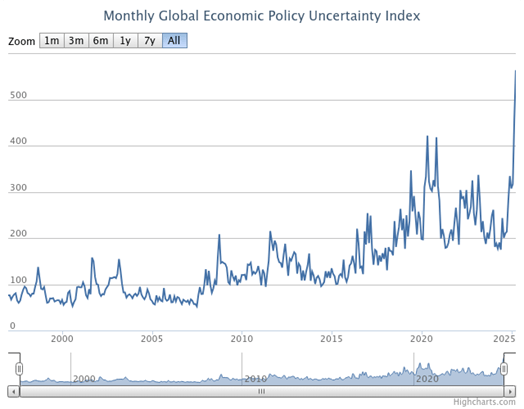
That’s exactly what it’s been doing. As Alex Shahidi points out, gold has managed to best global stocks – in terms of average annualized returns – by roughly 70% since 2001; a period, not so coincidentally, that has seen popular uncertainty metrics – including the World Uncertainty Index and Economic Policy Uncertainty Index – rise to their highest recorded levels, fueled by a seemingly endless string of profound global shocks that include:

  • the 9/11 attacks;
  • the global financial crisis;
  • the COVID-19 pandemic;
  • Europe’s largest ground war since World War II;
  • and obscene levels of fiscal profligacy poised to trigger a massive global debt crisis.

Chart courtesy of Economic Policy Uncertainty

Central Banks Have Been Net Purchasers of Gold Every Year Since 2010

It is, in fact, this rising uncertainty – particularly that which threatens dollar reliability and stability – that’s largely responsible for another highly impactful source of gold demand: central banks. Central banks have been net purchasers of gold every year since 2010. And since 2022…the same year Russia saw half its global reserves frozen by the West as punishment for Moscow’s invasion of Ukraine…central bank gold demand has been at or near record levels, something Alex Shahidi references in his public embrace of the metal.

“With its surprisingly strong historical returns over the long run, high liquidity and strong central bank support, it can be a valuable portfolio tool that offers diversification, inflation protection and stability during market turmoil,” Shahidi writes, adding:

“While not a conventional holding for all investors, gold’s unique attributes and proven track record make it worth considering as part of a well-diversified investment portfolio.”

For that matter, Shahidi’s pro-gold posture is hardly “conventional” for a key person at a billion-dollar asset manager. But in the words of the immortal Bob Dylan, the times they are a-changin’. And the way in which they’re “a-changin’” suggests the possibility that uncertainty might become a permanent part of the global landscape.

Should that disconcerting eventuality come to pass, then gold may be viewed not only as a standard portfolio holding, but also as a hedge deemed so critical that those advisors who opt against owning it on behalf of their clients could one day be seen as negligent for refusing to do so.

This post is created and published for general information purposes only. The Gold Strategist blog and Bob Yetman disclaim responsibility for any liability or loss incurred as a consequence of the use or application, either directly or indirectly, of any information presented herein. Nothing contained in this post – or any other post featured at this blog – should be construed as a solicitation or recommendation to engage in any financial transaction. You should seek the advice of a qualified professional before making any changes to your personal financial profile.

Blog at WordPress.com.

Up ↑